
Speed to lead: the follow-up math that beats hiring more salespeople
Before you hire another salesperson, measure how long your leads wait for a first response. Fixing speed to lead is cheaper than a hire, and in most service businesses, it returns more revenue.
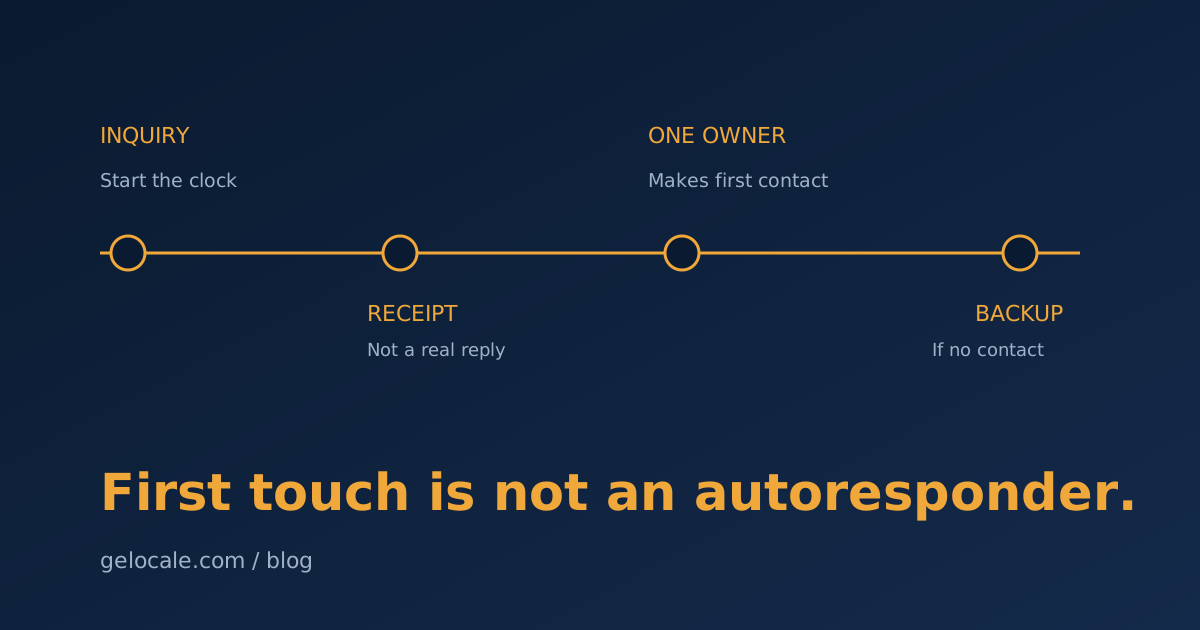
"Speed to lead" is one of those phrases that sounds like sales-bro jargon until you look at the numbers. Then it becomes the cheapest growth lever most service businesses are ignoring.
Here is the short version: the faster you respond to a new lead, the more of them you close. Not marginally more. Dramatically more. And in most businesses I audit, fixing response time costs less than one month of one salesperson's salary, and outperforms the hire.
What speed to lead actually means
Speed to lead is the time between a prospect raising their hand (submitting a form, sending a DM, requesting a quote) and your business making meaningful first contact.
Not an autoresponder. Not a "thanks, we got your message" email. A real touch: a call, a personal text, a reply that shows a human read what they wrote.
Most owners guess their speed to lead is "an hour or two." When we actually measure it, the median is usually somewhere between four hours and two days. Weekend leads often wait until Monday afternoon. Those leads are not warm anymore. They are furniture.
The math nobody runs
Say you get 100 inquiries a month and close 15 of them. Someone on the team suggests hiring another salesperson to push that number up. Reasonable instinct, expensive fix.
Now run the other scenario. Industry research has shown for years that contacting a lead within five minutes instead of thirty makes you roughly 21x more likely to qualify them, and that a huge share of deals go to the vendor who responds first. You do not need the exact multiplier to act on the direction: fast response converts a meaningful chunk of leads that slow response loses forever.
Be conservative and assume fixing response time only rescues 10 of the 100 inquiries from going cold, and you close them at your normal rate. That is 1 to 2 extra clients a month, every month, from leads you already paid to generate.
Compare the two investments:
- New salesperson: $4,000 to $8,000/month, 2 to 3 months of ramp, needs leads to work anyway.
- Response-time fix: a routing rule, an alert, and a short auto-acknowledgment. A few hours of setup. Runs forever.
The salesperson works the same leaky bucket. The speed fix patches the bucket. Patch first, hire second.
Why teams are slow (it is not laziness)
Nobody decides to ignore leads. Response time dies from structure, not effort:
- The alert lands in the wrong place. A shared inbox nobody owns, a muted Slack channel, a CRM dashboard that gets checked "when there's time."
- Ownership is fuzzy. When three people could respond, frequently nobody does. Everyone assumes someone else has it.
- After-hours leads have no path. A lead that arrives at 7pm Friday should get something before Monday. Usually it gets nothing.
- The first response requires thinking. If every reply has to be composed from scratch, replies get deferred. Deferred means forgotten.
Notice that none of these are fixed by hiring. A new salesperson inherits the same broken routing.
The fix: a five-minute first touch, systematized
You do not need a call center. You need four small pieces of plumbing:
1. One alert, one owner
Every new lead triggers an alert to one named person through a channel they genuinely check: personal SMS or a phone push notification, not email. If you have multiple people, use a simple rotation, but at any given moment exactly one person owns the next lead.
2. An instant acknowledgment that buys you time
Within sixty seconds of the form submit, the lead gets a short, human-sounding message: "Got your inquiry. I'm looking at it now and will reply properly within the hour. If it's urgent, call this number." This single message resets the lead's clock. They stop shopping for a few hours because someone answered.
Automate the acknowledgment. Never automate the pretense that it is the real response: say a proper reply is coming, then send one.
3. A first-touch template that takes 90 seconds to personalize
Write the skeleton of your first real reply once: greeting, one line referencing what they asked for, one qualifying question, a link to book a time. The responder personalizes two sentences and sends. Response time drops because the activation energy drops.
4. An escalation rule
If the owner of the lead has not made first contact within 15 minutes, the alert fires again, to them and to one backup. Deadlines without escalation are suggestions.
That is the whole system. It is the same pattern I use in every growth system I build: a written rule, enforced by plumbing, visible when it breaks.
Measure it or it will drift
Add one field to your CRM: first-contact timestamp. Report weekly on the median minutes from lead-in to first touch. That single number tells you more about next month's revenue than most pipeline dashboards, which, as I have written before, tend to lie anyway.
Targets that work for service businesses:
- Business hours: first real touch inside 5 to 15 minutes.
- Evenings/weekends: instant acknowledgment, real touch inside 12 hours.
- Median, not average. One heroic 30-second reply should not paper over twenty leads that waited a day.
When hiring is the answer
To be fair to the hire-more-people instinct: if your median response time is already under 15 minutes, your follow-up sequences run automatically, and your close rate is stable, then yes, more capacity means more revenue, and hiring makes sense. Speed to lead is not the last lever. It is the first one, because it is the cheapest and the fastest to pull.
Most businesses I look at are nowhere near that point. They are paying for leads, letting them cool for a day, and then paying salaries to work cold leads.
If you want a second set of eyes on where your leads actually stall (from form submit to booked call), that is exactly what I dig into in a Growth Systems Review. Bring your response-time number if you know it. If you don't know it, that is usually the finding.