
Small business automation: what to automate first (and what never to automate)
Most small business automation advice is a list of 50 tools. What owners actually need is an order of operations: the four things to automate first, and the short list you should never hand to a robot.
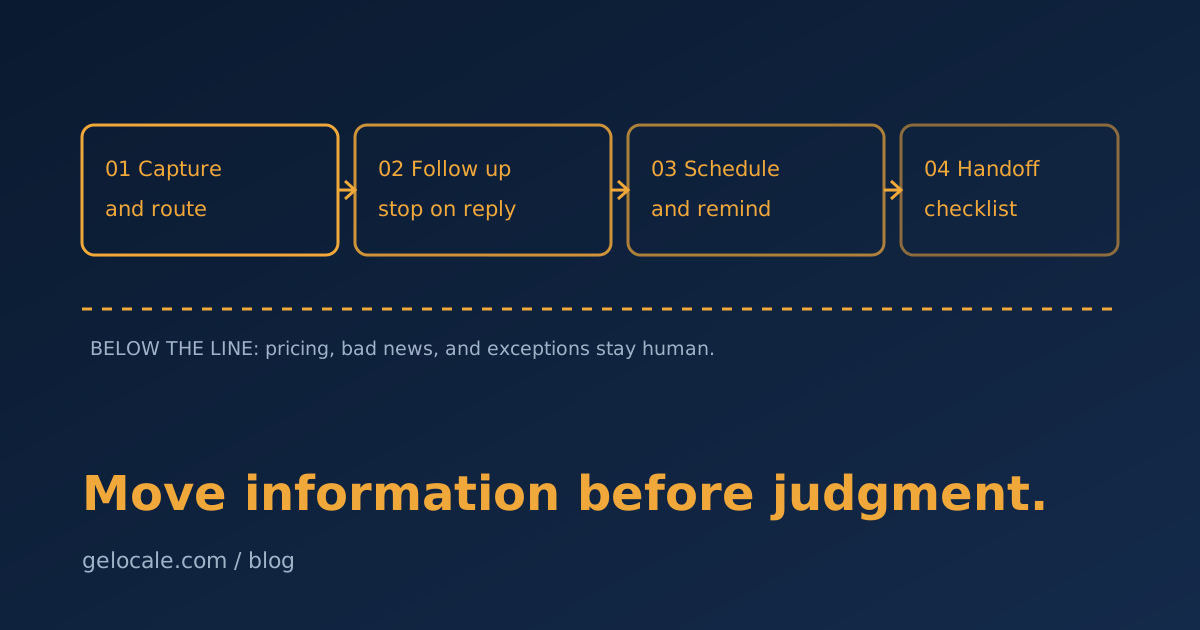
Search for "small business automation" and you will find two kinds of advice: breathless lists of 50 tools you should buy, and vague encouragement to "automate the boring stuff."
Neither answers the question owners actually ask me: what should I automate first? Order matters. Automate the wrong thing first and you burn your budget, annoy your customers, and conclude automation "doesn't work for us." Automate the right thing first and it pays for everything that comes after.
Here is the order I use, and, just as important, the short list of things I never automate at all.
The rule that decides the order
Before any tool talk, one principle: automate the transfer of information before you automate the judgment about it.
Moving data between systems, sending a reminder, updating a record, firing an alert: machines do this perfectly and instantly. Deciding whether a lead is worth pursuing, what to quote, how to handle an unhappy client: that is judgment, and automating judgment early is how businesses embarrass themselves.
Every item below follows that rule.
What to automate first: the four workhorses
1. Lead capture and routing (week one)
The moment someone fills out a form, calls, or messages you, three things should happen without a human touching anything: the lead lands in your CRM with its source recorded, an alert goes to the one person responsible for responding, and the lead gets a short acknowledgment so they know a human is coming.
This is first because it protects revenue you have already paid for. Every hour a lead sits unseen, it decays. I have written a whole piece on the math behind speed to lead, and the summary is: this automation usually outperforms a new hire.
2. Follow-up sequences (week one or two)
The second-biggest leak in every small business: the first touch happens, then nothing. No second email, no nudge, no "still interested?" The lead did not say no. Nobody asked again.
Write a four-step follow-up: day 1, day 3, day 7, day 14, in plain language, and wire it to start when a lead goes quiet and to stop the instant they reply. That stop condition is not optional. A sequence that keeps mailing someone mid-conversation reads as exactly what it is: a robot nobody is supervising.
3. Scheduling and reminders (week two)
Every back-and-forth "does Tuesday work?" email is unpaid admin. A booking link with real availability kills the volley. The automated reminder (24 hours and 1 hour before) is the part that actually makes money, because it routinely cuts no-shows dramatically.
This one is popular to do first because it is easy. Fine, but only if leads are already being captured and followed up. A tidy calendar full of nothing is still nothing.
4. Handoffs and status updates (month two)
Client signs. Now what? In most businesses, "now what" is a person remembering to send a welcome email, create a folder, and add the project to a board. Sometimes they remember.
Turn the sale-to-delivery handoff into a checklist that triggers itself: welcome email out, workspace created, kickoff booking link sent, internal notification posted. Same for status updates: a weekly "here's where things stand" note assembled from data you already track. Clients rarely churn because work is slow. They churn because it is silent.
What never to automate
This list is shorter but it is load-bearing.
Bad news. Delays, price increases, mistakes. A templated apology is worse than no apology. The moment something goes wrong, a human writes the message.
The first real sales conversation. Automate getting the meeting booked; never automate the meeting. AI-written "personalized" outreach that pretends to be handcrafted burns trust you cannot buy back.
Anything you have not done manually at least twenty times. Automation is a photocopier: it duplicates whatever process you feed it, including a broken one. If you cannot write the steps down from memory, you are not ready to automate them: this is the difference between buying tools and building a system.
Judgment calls with money attached. Refund decisions, custom pricing, contract exceptions. Automate the routing (get the request in front of the right person fast), but a person makes the call.
A realistic 30-day sequence
- Week 1: lead capture into one CRM, instant alert to one owner, one-line acknowledgment message.
- Week 2: the four-step follow-up sequence with a hard stop on reply. Booking link with reminders.
- Week 3: no-show recovery ("we missed each other: grab a new time here") and a post-call follow-up template.
- Week 4: the sale-to-delivery handoff checklist, automated.
Total tooling cost for most service businesses: modest, usually the CRM you already pay for, plus a scheduler and maybe one automation platform. The bottleneck is not budget. It is writing down the rules the machines will follow.
How to know if it is working
Track three numbers, before and after: median minutes from lead-in to first touch, percentage of leads that receive at least four touches, and no-show rate. If those move, revenue follows, usually within a single sales cycle.
If you would rather have someone map the leaks before you start plumbing, a Growth Systems Review is exactly that: we walk through how a lead currently moves from first click to paid client, find where automation pays fastest, and put the fixes in order. The audit takes an hour. The order-of-operations mistake it prevents usually takes months to undo.