
The 30-minute ops audit: a DIY checklist for service businesses
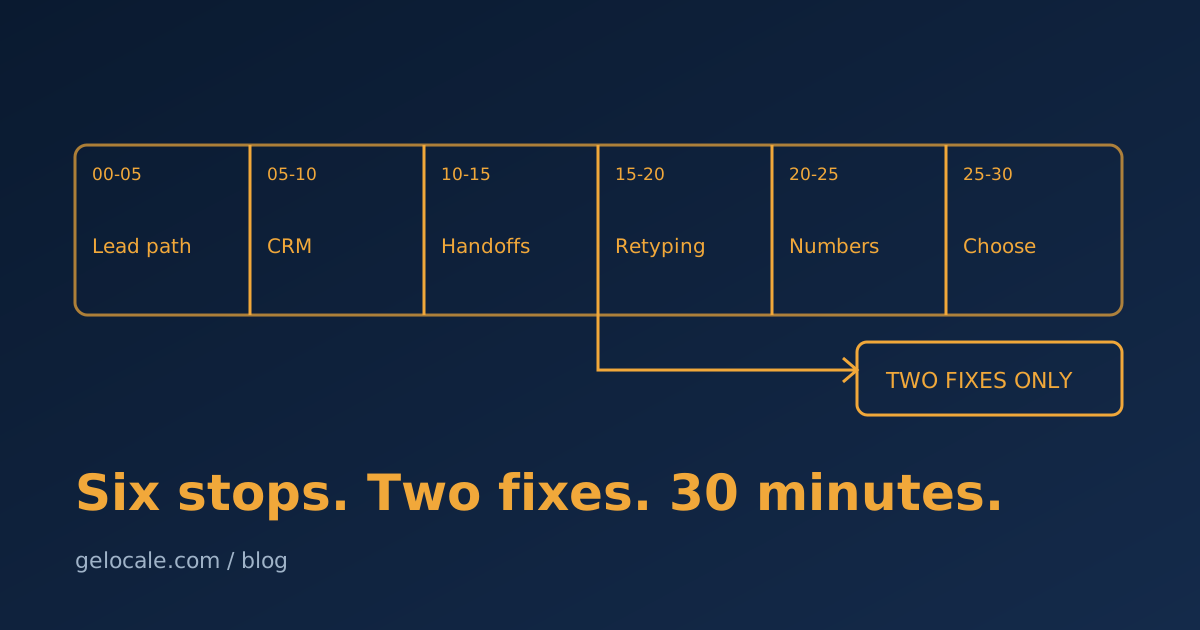
You do not need a six-week engagement to find your operational leaks. This 30-minute ops audit checklist walks through six stops (leads, CRM, handoffs, copy-paste work, and numbers) and ends with exactly two fixes.
Big consultancies will sell you an operations audit that takes six weeks and produces a deck nobody reads. Here is the version I actually run: a 30-minute ops audit you can do yourself, this week, with nothing but your own systems and a notepad.
The goal is not a complete map of your business. It is to find the two or three places where work silently leaks: leads that go quiet, handoffs that rely on memory, numbers nobody trusts. Those leaks are almost always invisible from the owner's seat, and almost always cheap to fix once named.
Set a timer. Six stops, five minutes each.
Minutes 0 to 5: Follow one lead through the pipes
Pick a real lead from the last two weeks (ideally one that did not close) and trace its actual journey. Not the journey your process doc describes. The real one.
- Where did it land first? (Inbox? CRM? Someone's DMs?)
- How long until a human made meaningful first contact?
- How many follow-up touches did it get after that?
- Where is it right now, and does its status reflect reality?
Write down every gap between "what should happen" and "what happened." In most audits this first stop alone finds the biggest leak: response time measured in hours or days, and follow-up that stopped after one attempt. If that is you, the speed-to-lead math should be the next thing you read.
Minutes 5 to 10: Open your CRM and count the fiction
Look at your active pipeline and answer honestly:
- How many deals have had no activity in 30+ days?
- How many are sitting in a stage that describes something you did ("proposal sent") rather than something the prospect committed to?
- If you closed only the deals you genuinely believe in, what percentage of the displayed pipeline number survives?
If the honest number is less than half the displayed number, your CRM is decorative. That is fixable (stale-deal auto-rules and commitment-based stages, which I covered in why your CRM is lying about pipeline) but you cannot fix what you have not admitted.
Minutes 10 to 15: List the handoffs that live in someone's head
A handoff is any moment where work passes between people or stages: sale to delivery, delivery to invoicing, inquiry to quote. For each one, ask a single question: if the person who normally does this were out sick this week, would it still happen?
- Sale closed → onboarding starts: automatic, checklist, or memory?
- Work delivered → invoice sent: automatic, checklist, or memory?
- Client question → answered within a day: owned by a named person, or "whoever sees it"?
Every "memory" answer is a future dropped ball with a date you do not know yet. You do not need to fix these in the next five minutes. Just get them out of heads and onto the list.
Minutes 15 to 20: Find the copy-paste jobs
Ask yourself (or your team, if you can grab them for two minutes): what information do you retype or copy from one place to another every week?
Common answers: form submissions into the CRM, CRM data into invoices, calendar bookings into a project board, the same status update into three different chats. Each one is a robot's job being done by a salary. Individually they look tiny: four minutes here, six there. Multiply by frequency and by everyone who does them, and this is routinely a full workday per week, spent on typing that a $30/month integration would do without errors.
Rank them by frequency. The top two go on the fix list.
Minutes 20 to 25: Check which numbers you actually trust
Write down the three numbers you would want on a single dashboard: for most service businesses that is leads this month, booked calls this month, revenue this month. Now answer for each:
- Can you get it in under one minute, without asking anyone?
- Do you believe it when you see it?
A "no" on either means decisions are being made on vibes. The fix is rarely a fancy BI tool. It is usually just agreeing on one source of truth per number and wiring it to update itself.
Minutes 25 to 30: Pick two fixes. Only two.
You now have a list of leaks. The audit fails if it becomes a fourteen-item improvement program that starts never. Pick exactly two, using one criterion: which leak, if plugged, returns the most money or hours for the least setup effort?
In the audits I run, the winners are almost always the same pair: lead response time (alert + acknowledgment + one owner) and follow-up automation (a four-step sequence with a stop-on-reply). Both are days, not months, to implement (a sensible first move if you are wondering what to automate first).
Put a name and a date on each fix. An audit without an owner and a deadline is a journal entry.
Do this quarterly
The 30-minute version is not a substitute for a deep operational review. It is a smoke detector. Run it once a quarter. Systems drift: stages get skipped, automations get paused "temporarily," new tools sneak in and fragment the data. Twenty minutes of honest tracing catches the drift while it is still cheap.
And if the audit turns up more plumbing than you want to touch yourself, that is the exact job of a Growth Systems Review: I trace the full lead-to-client path with you, put numbers on the leaks, and hand you a fix list in priority order. You can bring this checklist. Half the diagnosis will already be done.